
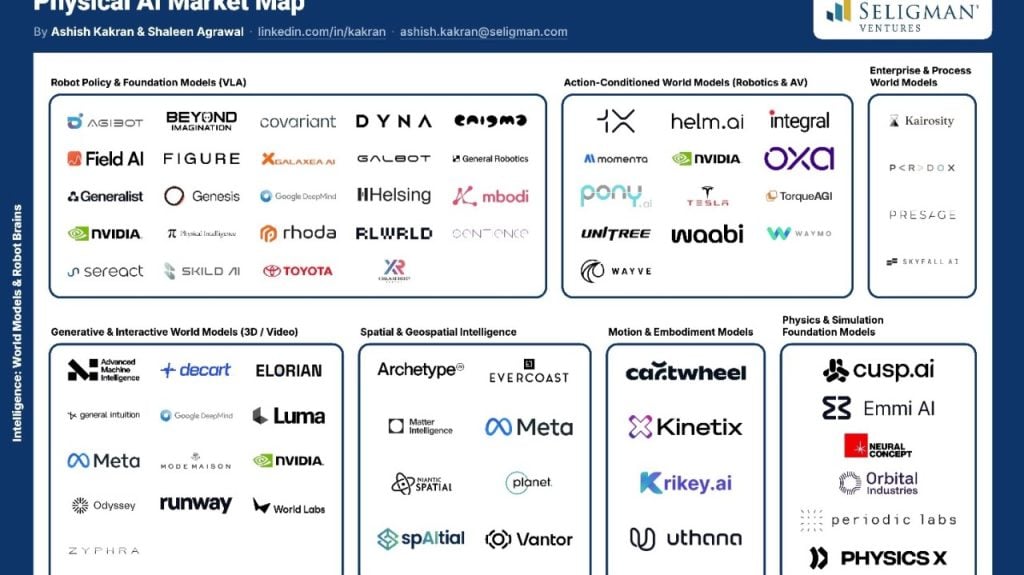

This is Part I of The Action Stack, a four-part series on the companies building physical AI and where value may actually accrue. At Seligman Ventures, we ( Shaleen Agrawal, Umesh Padval, Eddie Ackerman) mapped 500+ companies across models, robotics, deployment, and infrastructure. This series is the argument behind the map.
The last wave of AI was about language.
Models learned to write, summarize, search, code, and answer questions with remarkable fluency. That changed how people interact with software. But getting AI systems to act reliably in the real world is a different challenge altogether.
A bad answer from a chatbot is annoying. A bad action from a robot can damage equipment, ruin a production run, or cause an accident. Once AI moves from generating words to making decisions with real consequences, reliability stops being a nice feature and becomes the minimum requirement.
That is why world models are getting so much attention.
What a world model actually does
At its simplest, a world model tries to answer one question: If I take this action, what happens next? Give the model the current state of an environment and a possible action, and it predicts the likely future state. That may sound straightforward, but it is fundamentally different from many systems that are currently described as “world models.”
A video generator, for example, can produce a convincing sequence of images. It may understand that a ball should roll downhill or that a person walking across a room should stay roughly consistent from frame to frame. But producing plausible pixels is not the same as understanding the consequences of an action.
For a robot, that distinction is everything. It needs to know whether a glass will slip out of its gripper, whether a box will fall when another box is removed, or whether the path it is about to take will still be clear three seconds from now.
There is also an important distinction between a world model and a robot policy.
A vision-language-action model, or VLA, typically takes in what the robot sees along with an instruction and produces an action. In other words: observe, decide, move.
A world model adds another step. It allows the system to consider what different actions might lead to before committing to one.
In practice, these categories are beginning to converge. The distinction matters less as a taxonomy than as a way to understand what capability the system actually has.
The terminology is getting ahead of the technology
“World model” has quickly become one of those AI terms that can mean almost anything. Some companies use it to describe interactive 3D environments. Others use it for video generation. Robotics companies may use the same language for models that predict physical outcomes or help control machines.
We care less about the label and more about the underlying capability. Does the system maintain persistent objects? Does it understand geometry? Does it preserve physical constraints over time? Can it condition its prediction on a specific action?And, most importantly, does that prediction actually improve the system’s ability to act?
Those questions are far more useful than asking whether a company calls its product a world model.
Why video still matters
One of the more promising developments is the convergence between video models and robotics.
Video gives models a rich record of how the world changes over time. Objects fall. People open doors. Liquids pour. Vehicles move through traffic. Tools interact with materials. A model can learn a surprising amount about physical behavior before it ever controls a robot.
That makes video a useful starting point. But it is only a starting point. Watching a person pick up a coffee mug does not automatically teach a robot arm how much force to apply through a particular gripper. Human video does not capture the exact geometry, latency, torque limits, sensor noise, or failure modes of a specific machine.
Eventually, the model has to encounter the real system. That is where simulation, teleoperation, and real robot data become important. The challenge is teaching a machine what its own actions do inside that world. And unlike a training set, the physical world does not stay still. A robot may encounter a new obstacle, a different surface, an unfamiliar object, or a failure its developers never anticipated. It cannot simply rely on what it knew when the model was trained. It has to learn from what happens after deployment without losing what it already knows.
The real bottleneck is action
AI systems are already very good at describing environments. The harder problem is anticipating consequences quickly and reliably enough to make decisions. This is difficult because the best predictive models can also be computationally expensive. A robot operating in real time cannot spend several seconds imagining every possible future before moving its arm.
The key is to make prediction cheap enough, fast enough, and reliable enough to remain inside the control loop. That turns inference for world models into an infrastructure problem of its own: it is not enough for a model to predict the right future if it cannot do so at the speed and cost a machine requires. The previous AI cycle taught machines to understand and generate information. The next one is about whether they can understand consequences and act on them.
But if action is the new frontier, a more interesting question follows: who gets better fastest once these systems enter the real world?
A robot in production sees things its training data never did. Every new obstacle, intervention, mistake, and recovery can become another lesson, but only for the company that captures it and can feed it back into the system. In physical AI, the moat may have less to do with the model you start with than the learning loop you own after deployment. That is where we will go next.